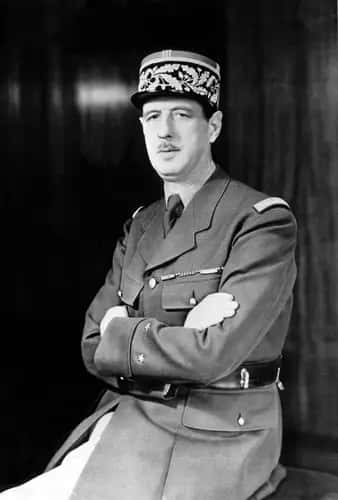
Born in Lille, France, Charles de Gaulle was raised in a family that emphasized military service and intellectual pursuits. As a child, he was a voracious reader and writer. He entered the national military academy at Saint-Cyr in 1909, graduating with distinction in 1911, and subsequently joined the 33rd Infantry Regiment under Colonel Philippe Pétain. De Gaulle served with honor during World War I, where he was wounded, decorated, and promoted. During the Battle of Verdun in 1916, he was left for dead, captured by German forces, and spent the remainder of the war attempting to escape from prisoner-of-war camps. After his release, Pétain, by then a Marshal of France, became his mentor. Throughout the 1920s, de Gaulle quickly advanced through the military ranks, serving in Poland, where he contributed to repelling the Bolshevik offensive against Warsaw, and later in Syria and Lebanon. In 1934, he authored "The Army of the Future," a work advocating for mechanized warfare, a strategy that would later be employed by the Germans in their conquest of France.
Promoted to Brigadier General in 1940, de Gaulle became Undersecretary of War in Premier Paul Reynaud's cabinet. Vehemently opposing the Franco-German armistice, he fled to London in June 1940, where he organized the Free French Forces and rallied several French colonies to his cause, an act that resulted in a death sentence in absentia by a French military court. His forces achieved success in Syria, Madagascar, and North Africa, leading to his co-presidency of the French Committee of National Liberation in Algiers, which he later led solely. After World War II, de Gaulle briefly headed the provisional government of France before forming the Rassemblement du Peuple Français party, though he eventually retired from politics in 1953. The political crisis in Algeria in 1958 brought him back to prominence, and he became premier with decree powers, overseeing the drafting of a new constitution that strengthened the presidency. Inaugurated as the first President of the Fifth Republic in 1959, he worked to restore France's international standing by stabilizing the franc, fostering ties with West Germany, and establishing diplomatic relations with the People's Republic of China. He also promoted the development of French atomic weapons and withdrew France from NATO's integrated military command. Despite facing significant student protests and worker strikes in 1968, he was reelected, but resigned in 1969 after a defeat in a referendum on constitutional reform. He married Yvonne Vendroux in 1921, and they had a son, Philippe, and two daughters, Elizabeth and Anne. Charles de Gaulle died on November 9, 1970, from a heart attack at Colombey-les-Deux-Églises.
The Libra Ascendant weaves a tapestry of charm and diplomacy into the outward presentation, an archetypal seeker of harmony and balance who navigates the world with a graceful, often aesthetically attuned, approach. Yet, beneath this poised exterior lies the intense, probing depth of a Scorpio Sun, deeply entrenched in the second house of values and resources. This Sun sign signifies a core identity characterized by a powerful drive for transformation, a profound emotional landscape, and an unwavering pursuit of truth, even when it delves into the shadow. The Scorpio Sun in the second house suggests that self-worth and personal power are intrinsically linked to the ability to uncover hidden depths, to master resources, and to engage in processes of profound personal alchemy, often through confronting and integrating what is concealed.
The emotional world, illuminated by a Moon in Aries in the sixth house, reveals a dynamic and pioneering spirit, yearning for independence and the thrill of the initial spark in daily life and work. This placement indicates a need for emotional autonomy, a quickness to react, and a passionate engagement with the practicalities of existence. The fiery Moon in Aries craves action and initiative in its routines, potentially leading to impatience with stagnation or a tendency to forge ahead with bold, sometimes impulsive, emotional responses. The intellectual currents, guided by Mercury and Venus in Sagittarius in the second house, further emphasize a philosophical, expansive approach to understanding values and meaning, seeking wisdom and higher truths that inform their sense of self and what they deem precious. Finally, Mars in Aquarius in the fourth house grounds this dynamic individual in a revolutionary, humanitarian spirit within the private sphere, suggesting a desire for unconventional foundations and a forward-thinking approach to home and family, often expressing their drive through innovative or socially conscious endeavors that reshape their roots.
Click any specific placement or mathematical aspect below to magically discover an entire database of famous figures who share this exact geometric DNA.