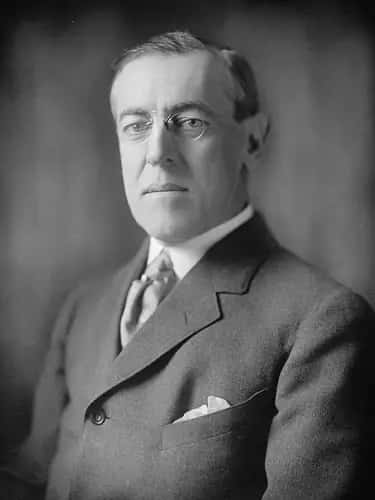
Born on December 29, 1856, Woodrow Wilson, the son of a Presbyterian minister, pursued higher education at Princeton and Johns Hopkins Universities, earning his Ph.D. in 1885. His doctoral work culminated in his influential book on American government, "Congressional Government." Following teaching positions at Bryn Mawr and Wesleyan from 1885 to 1890, he joined Princeton University, where he became president in 1902, implementing reforms that significantly influenced American university education. In 1910, Wilson transitioned into politics as a Democrat, serving as governor of New Jersey from 1911 to 1913. His progressive reforms as governor garnered national attention, leading to his nomination for president in 1912. Benefiting from a split in the Republican party, Wilson won the presidency and initiated his "New Freedom" reform program, which included lowering tariffs, introducing a graduated income tax, establishing the Federal Reserve Act and the Federal Trade Commission, passing the Clayton Antitrust Act, and enacting laws for an eight-hour workday and against child labor. He married his second wife, Edith Galt, in 1915, and was reelected in 1916 on a platform of maintaining American neutrality in the European war.
Despite his initial pledge, the United States was drawn into World War I, with Wilson declaring war on Germany in April 1917. He subsequently proposed a peace plan known as the "Fourteen Points," which brought Germany to the negotiating table in late 1918. Wilson attended the Versailles Peace Conference, where his vision for a lasting peace, particularly the creation of a League of Nations, faced the complexities of international diplomacy. Upon his return to America, his proposal for the League of Nations encountered significant opposition in Congress, partly due to his inflexibility, and ultimately failed to gain ratification. In September 1919, Wilson suffered a collapse, and for the remainder of his term until his retirement in 1921, he conducted official business from his bedside with the assistance of his wife, Edith Galt Wilson, who served as an intermediary for many decisions. He retired to seclusion in 1921 and passed away on February 3, 1924, in Washington, D.C., at the age of 67, due to a stroke and other heart-related complications. Wilson is recognized for his intellectual capacity and high-minded ideals, though his rigidity in certain aspects contributed to the ultimate defeat of his most significant foreign policy objective.
The Libran Ascendant paints a picture of a public face that is inherently diplomatic, charming, and driven by a deep desire for harmony and balance in all interactions. This individual approaches the world with an aesthetic sensibility, seeking fairness and beauty in their surroundings and relationships. Their outward demeanor is often one of grace and consideration, making them skilled mediators and natural diplomats who value partnership above all else. This is someone who strives to see all sides of a situation, fostering connection and understanding, though they may at times struggle with decisiveness due to the inherent need to weigh every option. The Capricorn Sun, however, anchors this airy facade with a profound sense of responsibility, ambition, and a practical, disciplined approach to life. Placed in the third house of communication and immediate environment, this Sun signifies a core identity forged through rigorous thought, focused learning, and a desire to master the skills necessary for tangible achievement. The Capricornian drive for competence and recognition fuels their intellectual pursuits and their ability to articulate complex ideas with authority and precision, often manifesting as a serious and goal-oriented communicator.
The emotional landscape is a fascinating blend, with the Moon, Mercury, Venus, and Mars all residing in innovative Aquarius within the intimate fourth house of home and roots. This Aquarian stellium suggests an emotional nature that is highly intellectual, progressive, and values freedom and individuality, even within the most private spheres of life. There's a deep-seated need for emotional stimulation through ideas, social connection with like-minded individuals, and a desire to bring about change or reform within their personal world or family structure. The mind, represented by Mercury, is sharp, unconventional, and drawn to abstract thought, influencing how they process information and communicate within their closest relationships. Venus here indicates a love for intellectual companionship and friendships that offer a sense of shared purpose or humanitarian ideals, while Mars fuels a drive to act on these progressive ideas, often through collaborative efforts or by challenging established norms within the home. This placement suggests a home life that is unconventional, perhaps filled with intellectual discourse, a focus on social causes, or a desire to create a space that fosters innovation and personal freedom for all its inhabitants.
Click any specific placement or mathematical aspect below to magically discover an entire database of famous figures who share this exact geometric DNA.