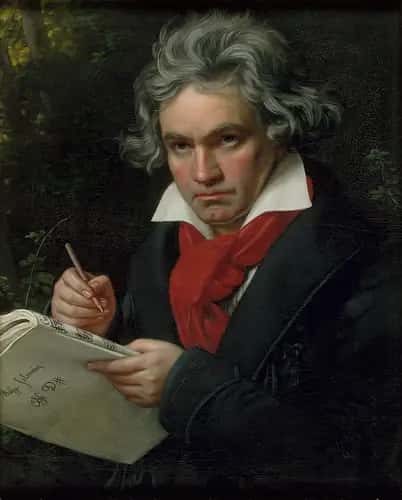
Ludwig van Beethoven, born in Bonn around December 16, 1770, was a German composer and pianist who became a pivotal figure in the transition between the Classical and Romantic eras. He exhibited musical talent from an early age, receiving instruction from his father, Johann van Beethoven, and later from composer Christian Gottlob Neefe. At 21, he relocated to Vienna, where he furthered his studies in composition with Joseph Haydn and quickly established a reputation as a virtuoso pianist. Beethoven resided in Vienna for the remainder of his life, but by his late twenties, his hearing began to decline, progressing to near-complete deafness in his final decade. Despite this profound challenge, which led him to cease public conducting and performing by 1811, he continued to compose prolifically, creating many of his most celebrated works during these later years. His personal life was marked by chronic abdominal pain and the encroaching loss of hearing, which he documented in his Heiligenstadt Testament, yet he maintained a devoted circle of friends throughout his life.His romantic aspirations were often complicated by the rigid class structures of his time. His affection for Countess Julie Guicciardi, to whom he dedicated his Sonata No. 14 (the "Moonlight Sonata"), could not lead to marriage due to their differing social statuses. Similarly, his deep connection with Josephine Brunsvik, evidenced by numerous passionate letters, was ultimately thwarted when her family compelled her to withdraw, citing the potential loss of her children's custodianship if she married a commoner. His later life was also affected by ill health; he was bedridden for several months before his death on March 26, 1827, in Vienna, at the age of 56. An autopsy revealed significant liver damage and auditory nerve dilation, though the precise cause of his death remains a subject of historical debate, with theories ranging from alcoholic cirrhosis to lead poisoning. Beethoven's enduring legacy as one of the most recognized and influential composers is cemented by his extensive body of work, which includes nine symphonies, five piano concertos, 32 piano sonatas, and his only opera, "Fidelio."
The Ascendant in Scorpio casts a powerful, enigmatic aura, immediately signaling a depth of intensity and a profound desire to understand the hidden currents of life. This outward presentation suggests someone who approaches the world with a keen, probing intellect, unafraid to delve into the mysteries and complexities that others might shy away from. There's an inherent magnetism, a compelling presence that draws people in, hinting at a soul that has experienced much and carries a wisdom born of transformation. This Scorpionic veil, however, often conceals a fiercely independent spirit, one that values authenticity and seeks profound connections, capable of great loyalty once trust is earned, but equally formidable when betrayed. It is a persona that speaks of resilience, a capacity for deep emotional experience, and an unwavering pursuit of truth, no matter how uncomfortable it may be.
The core identity, illuminated by a Sun and Moon both in Sagittarius, reveals a spirit brimming with optimism, a love for freedom, and an insatiable thirst for knowledge and experience. This dual Sagittarian placement in the second house signifies that the pursuit of meaning and expansion is intrinsically tied to one's sense of security and personal values. There is a deep-seated need to feel that one's life is rich not just materially, but in terms of wisdom, philosophy, and broad horizons. The mind, further amplified by Mercury in Sagittarius in the same house, is geared towards exploration, seeking understanding through diverse perspectives and a philosophical outlook. While Venus in Capricorn in the third house brings a grounded, pragmatic approach to communication and short journeys, adding a layer of responsibility and structure to their interactions and learning, Mars in Gemini in the eighth house injects a dynamic, adaptable energy into areas of shared resources, intimacy, and psychological exploration. This Martian placement fuels a curiosity about the depths of human connection and transformation, prompting a desire to investigate and exchange ideas in profound, often complex, ways.
Click any specific placement or mathematical aspect below to magically discover an entire database of famous figures who share this exact geometric DNA.