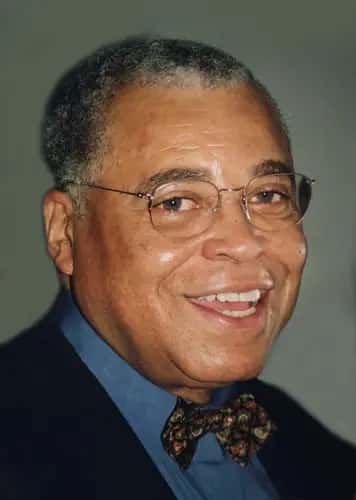
James Earl Jones, born on January 17, 1931, was the son of a prizefighter-turned-actor and was raised by his maternal grandmother on a Michigan farm. He faced a significant challenge in his youth, struggling with a stutter that caused him to rarely speak between the ages of four and a half and fourteen. A professor, recognizing his talent for poetry, encouraged him to recite his works aloud, which helped him overcome his speech impediment and sparked his interest in acting. Initially pursuing medicine at the University of Michigan, he later switched to drama. Following a period of service in the army, he enrolled in a New York drama school. His Broadway debut occurred in 1957, leading to acclaimed performances in productions such as the title roles in "Othello" and "The Emperor Jones" in 1964. He earned his first Tony Award for "The Great White Hope" (1966-1968), a role he reprised in the 1970 film adaptation, which garnered him an Academy Award nomination. His film career began in 1964, and he notably portrayed the first American black president in the 1972 film "The Man."
Jones achieved international recognition for his distinctive, deep voice, most famously as the masked character Darth Vader in the "Star Wars" saga, beginning in 1977. His stage career continued to flourish, earning him a second Tony Award for "Fences" in 1986 and a Special Tony Award for Lifetime Achievement in 2017. Throughout his career, he received numerous honors, including induction into the American Theater Hall of Fame in 1985, the National Medal of Arts in 1992, the Kennedy Center Honor in 2002, the Screen Actors Guild Life Achievement Award in 2009, and an Honorary Academy Award in 2011. In his personal life, he was married to actress Julienne Marie from 1968 to 1972. He later married actress Cecilia Hart in 1982, with whom he had a son, Flynn. Hart passed away in 2016. James Earl Jones died on September 9, 2024, at his home in Pawling, New York, at the age of 93.
With the Ascendant, Sun, and Moon all aligned in the stoic, ambitious sign of Capricorn, and residing within the first house of self and identity, this individual embodies a profound sense of responsibility and a relentless drive towards mastery. The core identity is forged in the fires of discipline, pragmatism, and a deep-seated need to build something lasting and significant. Emotionally, there is a reserved strength, a capacity for enduring hardship, and a desire for security that often manifests as a quiet determination. The outward persona is one of competence, maturity, and an unwavering focus on goals, often appearing self-possessed and in control, even when navigating internal complexities. This Capricornian configuration suggests a soul that learns through experience, shoulders burdens with grace, and finds its greatest fulfillment in achieving tangible results and contributing to the world in a meaningful, structured way.
The placement of Mercury in Capricorn within the twelfth house hints at a mind that processes information through a lens of deep introspection and long-term planning, often grappling with inner critiques or past lessons that inform present decisions. While the Venus in Sagittarius in the eleventh house brings a yearning for expansive social connections, intellectual exploration, and a more optimistic, freedom-loving approach to friendships and group endeavors, it can create a fascinating tension with the Saturnian core. The Mars in Leo in the seventh house introduces a powerful dynamic to relationships and partnerships; here, a passionate, creative, and perhaps even dramatic energy is projected onto others, seeking recognition and admiration within intimate bonds. This creates a compelling blend of the disciplined builder and the courageous performer, constantly seeking to integrate inner structure with outward expression and connection.
Click any specific placement or mathematical aspect below to magically discover an entire database of famous figures who share this exact geometric DNA.