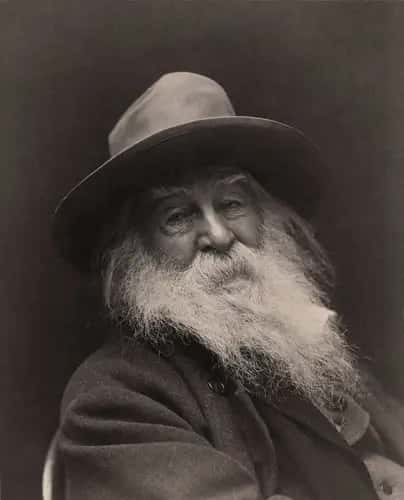
Born in a farming village on Long Island, New York, in 1819, Walt Whitman was the second of nine children to a Quaker house-builder father. He developed a close relationship with his mother throughout his life. After receiving only an elementary education, Whitman embarked on a path of self-education through extensive reading and held various jobs, including printer, journalist, and schoolteacher, between 1832 and 1845. In 1846, he became an editor for the Brooklyn Eagle, but his progressive views, particularly his support for abolitionism and free soil, led to his termination. A subsequent two-week train journey to New Orleans for a newspaper job exposed him to a vast expanse of the country, significantly broadening his perspective and influencing his poetic vision. Unable to find a publisher, Whitman self-published the first edition of "Leaves of Grass" in 1855, a collection of twelve poems that garnered praise from figures like Ralph Waldo Emerson, despite initial mixed critical reception.
In 1862, Whitman moved to Virginia to care for his brother, who had been injured during the Civil War. The profound suffering he witnessed during this period inspired him to volunteer in Washington, D.C. hospitals, where he served for 11 years while also working as an army paymaster and later for the Department of the Interior. A debilitating stroke in 1873 resulted in paralysis, forcing him to leave his government position and relocate to Camden, New Jersey, to live with his brother George. Despite his declining health and increasing feebleness, Whitman continued to write brief poems, published "November Boughs" in 1888, and received numerous visitors from both the United States and abroad. Before his death, he completed "A Backward Glance O'er Travel'd Roads." Whitman passed away on March 26, 1892, in Camden, New Jersey, at the age of 72, due to complications from pleurisy, consumption, tuberculosis, and nephritis.
With an Ascendant in Pisces, there is an immediate impression of a deeply empathetic and imaginative soul, one who moves through the world with a gentle, intuitive grace. This Piscean veil softens the edges, creating a persona that is often perceived as artistic, compassionate, and perhaps a little elusive. Yet, beneath this dreamy exterior lies a vibrant Gemini Sun, housed within the communicative third house. This Gemini Sun craves intellectual stimulation, revels in connection, and possesses a quick, adaptable mind. The inherent duality of Gemini fuels a multifaceted identity, a constant interplay between the desire for understanding and the drive to express myriad ideas. The third house placement amplifies this, making communication, learning, and sibling-like relationships central to their sense of self and purpose.
The emotional landscape is painted with the bold, passionate hues of a Leo Moon in the sixth house of daily routines and service. This Moon sign yearns for recognition, creative expression, and a sense of pride in their work and contributions. There's a deep-seated need to feel valued and to bring warmth and enthusiasm to their everyday life. The sixth house placement suggests that this desire for praise and creative fulfillment is often found through diligent effort, practical application, and a commitment to their responsibilities. When this emotional core is met, it fuels a generous and loyal spirit. With Venus and Mars both in the first house, the first in Taurus and the latter in Aries, there is a powerful, instinctual drive to assert individuality and to manifest desires. Venus in Taurus grounds this persona in a love for beauty, comfort, and sensual experience, while Mars in Aries injects a fierce, pioneering energy, a willingness to initiate and to conquer, creating a compelling blend of grounded sensuality and assertive action that is immediately apparent to others.
Click any specific placement or mathematical aspect below to magically discover an entire database of famous figures who share this exact geometric DNA.