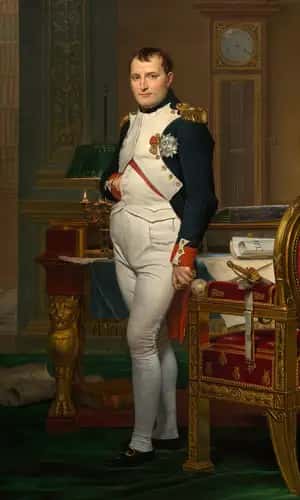
Born on August 15, 1769, as the fourth of thirteen children to an aristocratic Corsican family, Napoléon Bonaparte entered military school at the age of ten in 1779, earning a commission by the time he was sixteen. During his schooling, he developed an early appreciation for independent military command. His career rapidly advanced during the French Revolution; by 1793, he commanded the artillery at the siege of Toulon and was promoted to brigadier general at age 24. A striking military strategist, he was known for his tactical brilliance. In 1798, he embarked on an expedition to Egypt, capturing Malta and defeating the Mamluks at the Battle of the Pyramids before the French fleet was largely destroyed at the Battle of the Nile, prompting his return to France in 1799.
Upon his return, Napoléon staged a coup d'état on November 9, 1799, overthrowing the government and establishing himself as First Consul for ten years. He instituted significant and lasting reforms, including the Code Napoléon, educational reforms, a comprehensive tax code, improved road and sewer systems, and the establishment of the Banque de France. On December 2, 1804, he was crowned Napoléon I, Emperor of France, and later King of Italy in 1805. He expanded French influence across Europe through a series of military campaigns, notably invading Austria and Russia between 1805 and 1807. His attempt to enforce a boycott of British goods led to wars in Portugal and Spain. After incorporating the Papal States into France in 1809, he was excommunicated by Pope Pius VII. His disastrous invasion of Russia in 1812, unprepared for the harsh winter, led to a significant loss of men and materiel. Forced to abdicate on April 4, 1814, and exiled to Elba, he returned to France on February 28, 1815, initiating the period known as The Hundred Days. His final defeat occurred at the Battle of Waterloo on June 18, 1815, leading to his second abdication and exile to St. Helena in the South Atlantic. Napoléon married Josephine de Beauharnais in 1796; their childless marriage was dissolved in 1809. He then married Marie Louise, daughter of Holy Roman Emperor Francis II, in 1810, and she bore him a son, Napoléon Francis Joseph Charles, in 1811. Napoléon died of stomach cancer in exile on St. Helena on May 5, 1821, at the age of 51, and is buried in Paris. He remains a prominent cultural icon, the subject of numerous historical works and artistic portrayals.
With a Scorpio Ascendant, there is an immediate impression of intense depth and magnetic charisma, a presence that draws others in with an unspoken power and a keen, penetrating gaze. This outward presentation hints at a complex inner world, one that seeks profound connection and transformation, often through navigating the hidden currents of life. The Sun blazing in Leo in the tenth house of public life and career signifies a core identity driven by a radiant desire for recognition, leadership, and creative expression on a grand stage. This individual is meant to shine, to lead with passion and a regal bearing, carving out a significant place in the world through their inherent authority and vibrant spirit. The ambition here is not merely for success, but for a legacy built on authenticity and the courage to be seen.
The emotional landscape, governed by the Moon in Capricorn in the third house of communication and thought, reveals a deep-seated need for security, structure, and tangible accomplishment, tempered by a practical and disciplined approach to their inner world. Emotions are often processed with a serious, responsible air, seeking to build something lasting and meaningful through their thoughts and interactions. This can manifest as a sharp intellect and a methodical way of communicating ideas, often with a focus on conveying wisdom and practical knowledge. The Venus in Cancer in the ninth house brings a tender, nurturing, and deeply sentimental approach to higher learning, philosophy, and expansive worldviews, seeking emotional resonance and connection through shared beliefs and cultural exploration. Meanwhile, Mars in Virgo in the tenth house fuels a precise, dedicated, and analytical drive towards their public ambitions, meticulously honing their craft and contributing their skills with a desire for mastery and service in their chosen field.
Click any specific placement or mathematical aspect below to magically discover an entire database of famous figures who share this exact geometric DNA.