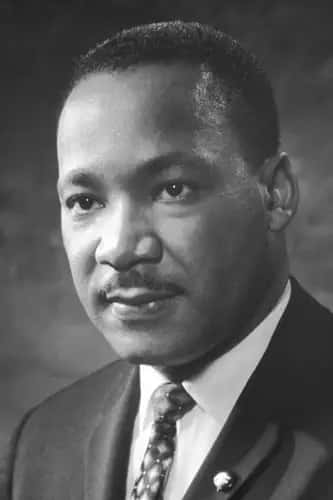
Martin Luther King, Jr. was born on January 15, 1929, into a prominent and progressive Black community in segregated Atlanta, Georgia. His father, Martin Luther King Sr., was a Baptist minister at Ebenezer Baptist Church, and King grew up in a family deeply involved in the ministry. Despite not experiencing poverty, he was exposed to his father's strong stance against racial injustice from an early age. King displayed early rhetorical talent, winning an oratorical contest in 1944. Initially uncomfortable with the emotionalism of fundamental Baptist services, he pursued a more liberal theological education at Morehouse College and Crozer Theological Seminary, where he excelled, becoming student body president and class valedictorian. He was ordained a minister in 1947, with his professors predicting his future as a significant leader.King's leadership emerged prominently in 1955 when he became the delegated spokesman for the Montgomery Bus Boycott, initiated after Rosa Parks' refusal to yield her seat. Following the boycott's successful desegregation of buses, King co-founded the Southern Christian Leadership Conference (SCLC), providing a platform for his nonviolent civil rights activism. His philosophy of passive resistance led to frequent arrests and widespread recognition as he championed causes such as the Southern student lunch counter sit-ins, the Freedom Rides, and marches in Birmingham, St. Augustine, and Selma. A defining moment was the 1963 March on Washington, where he delivered his iconic "I Have a Dream" speech to 200,000 people. Despite facing violence, including physical attacks and a bombing of his home, and intense FBI surveillance that attempted to discredit him, King remained committed to his mission. He received the Nobel Peace Prize in 1964. In his later years, King expanded his focus to include opposition to the Vietnam War and efforts to combat poverty, planning a Poor People's March on Washington. His final public address, delivered on April 3, 1968, in Memphis, Tennessee, included the prophetic "I have been to the mountaintop" speech. The following day, on April 4, 1968, he was assassinated. King married Coretta Scott in 1957, and they had four children: Yolanda Denise, Martin Luther King III, Dexter, and Bernice Albertine.
The earthy strength of a Taurus Ascendant forms the bedrock of your outward presentation, offering a grounded, steady presence that others find reassuring. This sign's influence lends a deliberate pace and a profound appreciation for the tangible world, manifesting as a desire for security, beauty, and sensory richness in your immediate environment. Beneath this calm exterior, the Capricorn Sun in the expansive ninth house reveals a core identity driven by ambition, long-term vision, and a deep-seated need for meaning and mastery. There is a powerful synthesis here, where the practical, building energy of Capricorn is directed towards higher learning, philosophical exploration, or perhaps a career that involves travel, foreign cultures, or the dissemination of knowledge. This individual is not just building for the sake of it, but building a life imbued with purpose and a grander understanding of the world.
The emotional landscape is painted with the ethereal hues of a Pisces Moon residing in the eleventh house of community and aspirations. This placement suggests a profoundly empathetic and intuitive emotional nature, where feelings are often experienced with great depth and sensitivity, and where a sense of belonging within a collective or a shared vision is paramount. Dreams and ideals can deeply influence the inner world, and there's a yearning for connection that transcends the mundane. Complementing this, Venus also in Pisces in the eleventh house amplifies the desire for harmonious relationships and aesthetic experiences within social circles, often drawing kindred spirits who share artistic or humanitarian pursuits. The Mercury in Aquarius in the tenth house indicates a unique, forward-thinking communication style, particularly in public or professional spheres, where innovative ideas and humanitarian concerns are expressed with clarity and conviction. Finally, Mars in Gemini in the second house injects a dynamic, versatile energy into the pursuit of resources and personal values, suggesting that financial security and self-worth are attained through adaptability, intellectual engagement, and perhaps juggling multiple income streams or interests.
Click any specific placement or mathematical aspect below to magically discover an entire database of famous figures who share this exact geometric DNA.