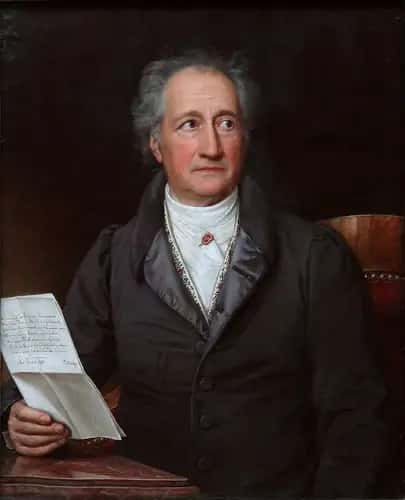
Born on August 28, 1749, in Frankfurt, Johann Wolfgang von Goethe was the son of Johann Kaspar Goethe, an imperial councilor, and Katharina Elisabeth Textor, a lively and perceptive woman. He received a comprehensive home education, becoming proficient in music, art, and six languages before attending Leipzig University to study law in 1765. Early literary influences included the Bible, Homer, and Klopstock's "Messiah." After a serious illness in 1768, he returned home, where he was influenced by a devout family friend and engaged in alchemical studies. He completed his law studies in Strasbourg in March 1770, a period that significantly developed his mind and talent. Goethe became a lawyer in 1771, and his first work was published in 1773. His novel "Die Leiden des Jungen Werthers" (1774), written after a romantic disappointment, caused a sensation and became legendary for inspiring imitative suicides among sensitive young readers. By 1775, Goethe's fame led to an invitation from the Duke of Saxe-Weimar, where he remained for the rest of his life, holding a central position as both a creative artist and a man of affairs, eventually becoming the chief minister of state.Except for two journeys to Italy, Goethe resided in Weimar, where he produced masterpieces, managed the local theater, and pursued scientific studies. He is credited with founding morphology, and his work on plants predated Darwin's theories. From 1794 until Friedrich Schiller's death in 1805, Goethe maintained a close association with the fellow writer, and together they aimed to imbue German literature with unprecedented seriousness and classical stature. His magnum opus, "Faust," took 60 years to complete, with the second part finished the year before his death. Goethe was known for his remarkable range, possessing talent in drawing, an interest in acting, and success as a theater director. His knowledge of antique art was extensive, and in science, he focused on biology, optics, and mineralogy, with practical pursuits extending to mining, economics, architecture, horticulture, and landscape gardening. After numerous romantic relationships, Goethe met Christiane Vulpius in 1788, a worker in an artificial-flower factory, who moved in with him and bore five children, though only their son August (1789-1830) survived. In 1806, following an incident during the Napoleonic wars where Christiane reportedly intervened during a break-in by French soldiers, Goethe married her. Christiane died in 1816. Goethe passed away on March 22, 1832, in Weimar, Germany, at the age of 82, and was buried beside Schiller in the Princes' Vault.
The core of this individual's being is forged in the crucible of Virgo, a sign that seeks to understand the intricate workings of the world through meticulous analysis and a desire for practical improvement. Placed in the expansive Ninth House, this Virgo Sun yearns to dissect philosophical concepts, explore foreign cultures, and engage in deep, meaningful intellectual pursuits, always with an underlying drive to refine and perfect their understanding. This grounding in detail, however, is softened by a deeply empathetic and intuitive Pisces Moon residing in the communicative Third House. This lunar placement lends a profound emotional sensitivity, a rich inner world of dreams and imagination, and a compassionate approach to communication, though it can also manifest as a tendency to absorb the emotions of others or struggle with clear boundaries. The outward presentation, governed by a Scorpio Ascendant, is one of intense presence, magnetic allure, and a profound capacity for transformation. This persona draws others in with an enigmatic aura, hinting at a deep well of psychological insight and a powerful will that is not always immediately apparent.
The interplay between the analytical Virgo Sun and the intuitive Pisces Moon creates a fascinating dynamic: a mind that craves empirical evidence and logical structure, yet an emotional landscape that is fluid, imaginative, and deeply connected to the unseen currents of life. The Leo Mercury in the Ninth House further fuels a desire for eloquent expression of their philosophical explorations, lending a dramatic flair and a need for recognition in their intellectual endeavors. Professionally, the Venus in Virgo in the Tenth House suggests a dedication to service and refinement in their public life, seeking mastery and excellence in their chosen career path, often through meticulous work. The Mars in Capricorn in the Second House provides a potent engine for building tangible resources and establishing security, driving them with disciplined ambition and a pragmatic approach to manifesting their goals, ensuring that their deep insights and refined skills are translated into concrete achievements and a solid foundation.
Click any specific placement or mathematical aspect below to magically discover an entire database of famous figures who share this exact geometric DNA.