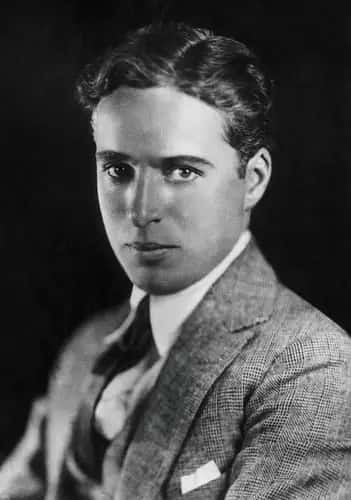
Born around April 16, 1889, Charles Chaplin was the younger son of music hall entertainers in England. His childhood was marked by hardship; his mother experienced physical and emotional problems, leading to her institutionalization from 1895, and with an alcoholic father unable to care for them, Charles and his older half-brother Sydney were placed in children's homes and workhouses. A gifted mime, Chaplin first appeared on stage at age five and made his professional debut with "The Lancashire Lads" at age ten, becoming their top tap dancer. At 14, he secured his first legitimate acting role as Billy the page boy in "Sherlock Holmes," which led to a career as a Vaudeville comedian. He first toured the United States in 1910 with the Fred Karno Repertoire Company, captivating American audiences. In 1912, during a return tour, Chaplin was offered a motion picture contract and joined Mack Sennett's Keystone Film Company in December 1913. He produced as many as 35 films annually, releasing his first, "Making a Living," in February 1914. Later that month, he created the costume for his enduring trademark character, the Tramp. His burgeoning success led him to the Essanay Company in 1915, where he released "The Tramp," and by 1916, he signed with the Mutual Film Corporation, producing hits like "The Floorwalker" and "The Vagabond.
After his contract with Mutual concluded in 1917, Chaplin established himself as an independent producer, building his own studios in Hollywood. In April 1919, he co-founded United Artists Corporation with Mary Pickford, Douglas Fairbanks, and D.W. Griffith, aiming to control his own productions. His notable works under this arrangement include the six-reel masterpiece "The Kid" (1921), "Gold Rush" (1925), "City Lights" (1931), "Modern Times" (1936), and "The Great Dictator" (1940), in which he spoke on screen for the first time. Despite a lack of formal education, Chaplin was a self-made artistic genius, writing his own scripts, authoring four books, and composing music for his films. His personal life included four marriages; his final union with Oona O'Neill, which began in 1943, lasted the rest of his life and produced eight children, including actress Geraldine Chaplin. Never becoming a U.S. citizen, Chaplin faced legal and political scrutiny, particularly regarding his left-of-center politics during the Cold War era. In September 1952, while he was traveling to London, the U.S. Attorney General revoked his re-entry permit. Chaplin chose to remain in exile, settling in an elegant manor near Vevey, Switzerland. He was knighted by the Queen in 1975 and died peacefully in his sleep on December 25, 1977, at the age of 88.
The Ascendant in Scorpio casts a powerful, magnetic first impression, hinting at a profound depth and an intense, penetrating gaze that seems to see beyond the surface. This persona is not one to shy away from the mysteries of life; rather, it actively seeks to uncover hidden truths and navigate the transformative currents of existence. With the Sun in Aries in the sixth house, the core identity is one of pioneering spirit and relentless drive, channeled into practical, everyday efforts and the mastery of skills. This Aries Sun finds its purpose through action, dedication, and the daily grind of self-improvement, bringing an unyielding courage and a pioneering zeal to their work and routines. The Moon, also in Scorpio and placed in the first house, reveals an emotional nature that is equally intense, deeply passionate, and possesses an innate need for control and profound emotional connection. Security is found in emotional depth and the ability to transform oneself and one's environment, making for a rich inner world that is rarely fully revealed.
This blend creates a fascinating dynamic where the outward intensity of the Scorpio Ascendant and Moon is fueled by the fiery, action-oriented Aries Sun in its house of service and daily life. There's a drive to prove oneself through diligent effort and a courageous approach to challenges, all while maintaining an aura of enigmatic power. The Mercury in Aries in the fifth house suggests a quick, direct, and impulsive mind, particularly when it comes to creative expression, romance, and self-expression, often leading to bold ideas and enthusiastic pronouncements. The Venus and Mars conjunction in Taurus in the seventh house speaks to a deep-seated need for stability, sensual pleasure, and harmonious partnerships, where attraction is rooted in shared values, loyalty, and tangible affection. This placement suggests a desire for lasting bonds and a grounded, sensual approach to relating, where love and desire are expressed through steadfast devotion and shared comfort.
Click any specific placement or mathematical aspect below to magically discover an entire database of famous figures who share this exact geometric DNA.